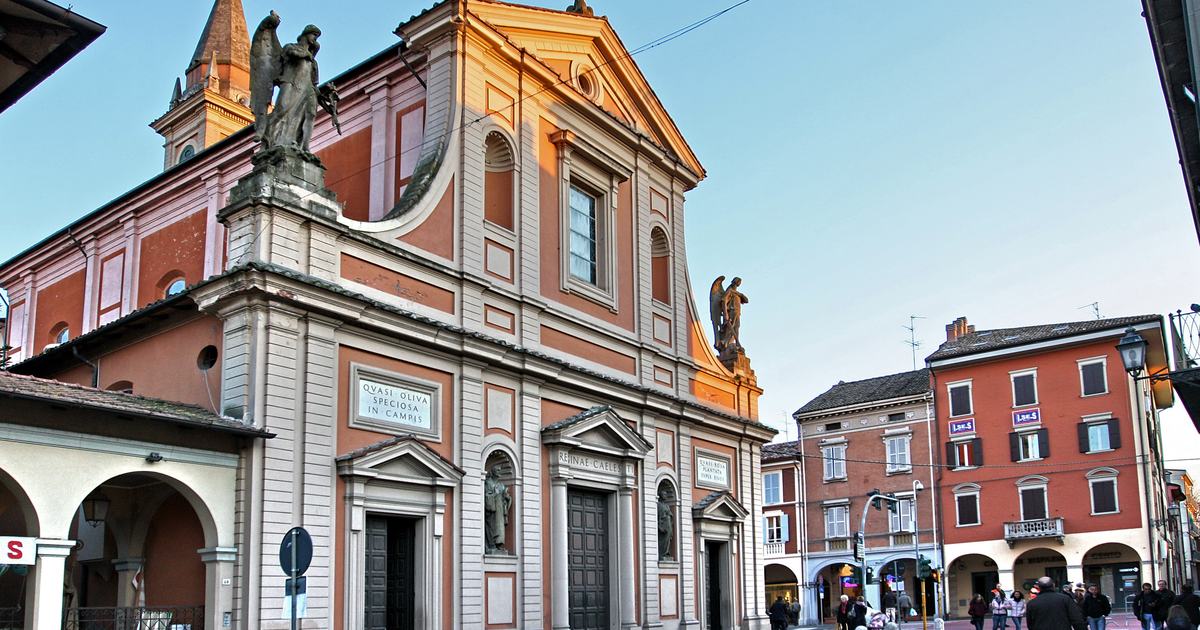

Church of Santa Maria Assunta in Castelfranco Emilia
The Church of Santa Maria Assunta is the oldest church in Castelfranco, as well as the town’s main place of worship. Built between 1226 and 1232, when Pope Gregory IX authorised the relocation of the Church of Santa Maria di Ambliano within the walls of Borgo Franco – now known as Castelfranco – it was initially smaller and had a single nave; in 1692, the building, which had fallen into disrepair, was replaced by a new church, completed in 1704. During the late 19th-century renovation, the two side aisles were added, the apse was enlarged, the portico on the south side was demolished, and two new doors were opened in the façade, in line with the aisles.
The façade was redesigned by Edoardo Collamarini in 1914; the bell tower, built in the late 17th century, was rebuilt in 1921.
Inside the church, the second altar on the left-hand side of the nave is dedicated to the town’s patron saint, Saint Donnino, whose feast day is on 9 October; beneath the altar lie the remains of Saint Prospero, which were donated by Pope Benedict XIV in 1750 to the members of the Confraternity of Suffrage from Castel Franco during a pilgrimage to Rome.
Nella Chiesa sono presenti le seguenti opere dell'artista castelfranchese Angelo Tavoni: il bassorilievo in terracotta "Ultima cena", i bassorilievi in terracotta "Battesimo di Cristo" e "Resurrezione di Cristo" sopra la porta d’ingresso, e il bassorilievo in terracotta patinata "Consacrazione della Chiesa di Santa Maria Assunta".
Find out if you recognize the prominent artists featured in the decorations of the historic church.
See if you can match the year to the Collamarini restoration project.
Discover the artist behind the famous painting ‘Beata Vergine Maria Assunta in cielo’
Discover the origins of the painting depicting Saint Barbara
Test your knowledge by identifying who sculpted the statues of Saints Giminiano and Petronio