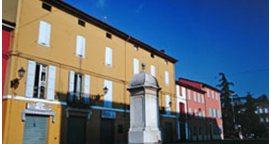

Garibaldi Square
Ever since its foundation, Castelfranco Emilia – characterised by an urban layout consisting of identical blocks – had lacked a proper square. For many centuries, it was the Via Emilia that served as an open space, bounded as it was by buildings on either side. It was not until around 1780 that a space described as an ‘open square’ appeared, occupying half of what is now Piazza Garibaldi. The other half was occupied by the Oratory of St Joseph and the adjoining cemetery.
In 1796, with the arrival of Napoleon’s army in Castelfranco, the Oratory and the cemetery were closed to worship and subsequently demolished, allowing the square to be doubled in length at the start of the nineteenth century (approximately twenty metres by eighty).
In the centre of the square stands the public fountain known as the “Fonte Garibaldi”, built in 1886 to a design by the engineer Modoni.
In 1993, the then Superintendency for Archaeological Heritage of Emilia-Romagna carried out an investigation into a vast area adjacent to the ancient walls of the Borgo Franco, founded by the Municipality of Bologna in 1227, bringing to light a medieval settlement; On this occasion, numerous artefacts were also discovered in what is now Piazza Garibaldi, bearing witness to the urban development of the historic centre since its foundation. Among these, a fragment of a funerary stone, dated 1302, stands out, featuring inscriptions in Gothic script and a rampant lion. Many of the artefacts recovered during this excavation campaign are now housed at the ‘Anton Celeste Simonini’ Civic Archaeological Museum, situated a short distance from the square.
What events are taking place in the square? Find out all about them